The Nasher Sculpture Center is currently presenting SURVEY: Antony Gormley, a retrospective on British artist Antony Gormley’s long and varied career in sculpture. His use of the human body in his artistic practice, whether it’s representational, transformative, or abstracted, is compelling. Even when abstracted or subtracted, the intent and context of the body within the work provides nuance and added emotional impact. There is something universally touching about seeing our form reflected in art. The effect evoked can be one of familiarity, but this connection between form and self can also create a lingering disquiet.
Although Gormley’s sculptures fill almost every space of the museum, demonstrating the evolution of his work, I find myself the most drawn towards the sculptures in his recent Block series (2019-2020), his 1991 sculpture, Sense, and Quantum Cloud XX (Tornado) from 2000.
Sense is a dense, solid, and ominous structure that is both industrial and minimal, lacking any ornamentation or imagery. On the top surface, there is a hole that leads to a large cavity in the center of the concrete mass. There are two additional holes on one of the sides connecting to the same cavity. Upon closer inspection, the cavity takes the form of a human body. Gormley often uses molds and casts of his own body in his work, providing life sized scale to his figures. In Sense, the subtracted form is created using the lost wax technique, in which a silicone mold is filled with a coat of hot wax and, which is melted away, leaving a void that is encapsulated by the concrete.
From a distance, the sculpture appears to simply be a concrete block, but the presence of the two handprints, linked to the hollowed-out form of arms descending into the darkness, creates a horrifying premise. Despite knowing that this sculpture was made using a cast and mold, I can’t help but imagine a person trapped in the unyielding cube of concrete. My mind substitutes the impression of the human body left in the cavity with the body itself. I think of dramatized crime TV shows where people are buried alive or disposed of in cement. It’s quite morbid and disturbing but unfortunately draws reference from real life. Similar to the figures in Pompeii that were entombed in ash, it’s as if this sculpture commemorates those who have been trapped.
Beyond these tangible real life scenarios, Sense also touches on a more metaphysical and intrinsic feeling. As uncomfortable as it may be to imagine, our bodies are simply sealed vessels for our insides, cloaked in shadow and only being brought to light in moments of vulnerability and injury. We can’t escape the form we live in, we must learn to move and grow within it. Living with a mild case of hypermobility, my joints ache and hurt frequently. It’s a strange feeling when I can tell something is not right or out of place, but I do not know how to fix it. Sense reflects this experience of internal functions and our lack of control over them. The shadowy figure trapped within the concrete prison is solidified, only revealed to us through the three holes in the unyielding material.
Across the gallery is a series of smaller sculptures: Heave (Block), Grasp (Block), and Grasp II (Block). The sculptures appear dense and heavy, the pieces of iron stacked and almost seamlessly connected to one another to form the boxy sculptures.
These small, abstracted, and rust colored sculptures do not immediately read as human figures. However, once placed in conversation with its neighboring Sense, the cuboid sculptures, formed
by stacked and overlapping geometric shapes, begin to form what my mind began to interpret as humanoid shapes. The Block series reflects a similar denseness as the solid outer appearance of Sense, though the smaller forms possess a sense of movement that the mass of cement does not. Although it is stationary, the added pieces and non-uniform surface express variety and rhythm.
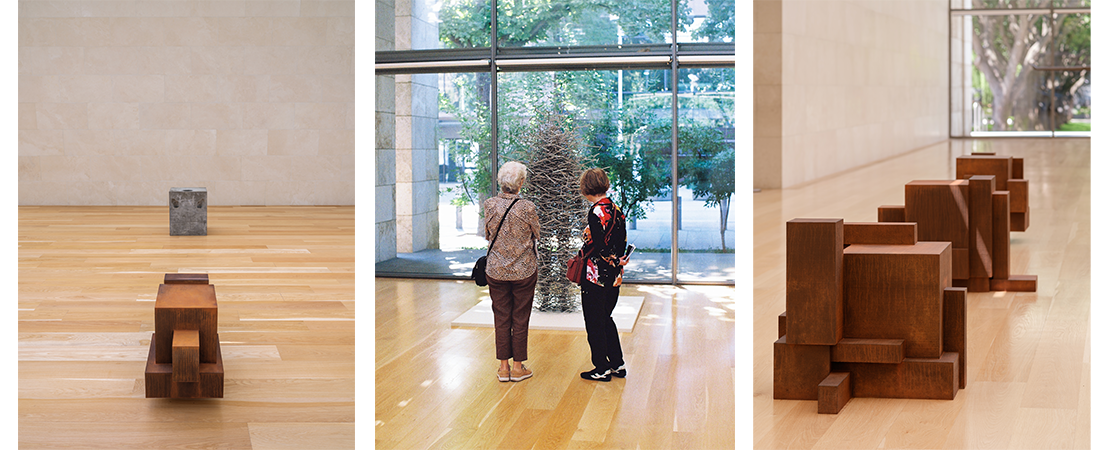
Sitting across from one another, these sculptures contradict one another. Sense solidifies the form around the human figure within while the three Block pieces hold the figures as their form. The counter form, or the air around these sculptures, have the same inverse: the air takes the form of a figure within the interior of Sense, while the space of the gallery is the counter form of Block.
The Block sculptures provide a different emotional experience than their eerie neighbor. I find them to be quite cute, their small stature stirring a maternal feeling. But their industrial material and compact appearance create a similar feeling of stiffness as Sense. While Sense’s material form traps the figure within it, the Block figures are the solidified materials. The forms themselves are petrified, unmoving. A moment of stillness akin to when you’re so exhausted or sore you can’t bring yourself to move.
Quantum Cloud XX (Tornado) (2000) stands in the back corner of Gallery 2. From first glance, its stature and form contrast that of Sense and the Blocks series. The overlapping stainless steel rods create a ghostly apparition.
The rods themselves aren’t in the formation of a figure, rather they create a cloud of industrial material that the shadowy figure inhabits. It is a stark contrast to previous sculptures discussed. Rather than cubic and geometric, the sculpture is full of energy. The figure and its form is somehow both distinct and implied. It’s hard to narrow down how and where the body is formed, only that it is.
Surprisingly, I find that this work also resonates with me on a similar level to Sense. The figure, though disembodied, is essentially trapped within the materials the sculpture is constructed by. Quantum Cloud’s form is being pierced and formed by the steel bars. While the sculpture breathes, the figure is stuck within the cloud of metal. Any attempt to remove the form from the sculpture will result in the dissolution of the body.
When looking at some of the other works on display, the cement material of Sense feels even more crushing. The multitude of iron bars in Quantum Cloud overlap to reveal the silhouette of a figure at their center. Despite the stainless steel bars trapping this figure in this tornado of metal, there are pockets of air and light that travel through the work. The work exists in a ghost-like state, not really there, but trapped nonetheless. In comparison, Sense weighs the figure down, the hollow form in direct opposition to the figure in Quantum Cloud.
In Sense, the weight of the materials engulf the figure and weigh it down, a reflection of feeling trapped within ourselves by external factors. The Block series are also weighed down, though in this instance it is by their own form. These two sculptures in particular have oppositional relations between form and counter form, but reflect similar feelings of encumbrance and how the human body can be imprisoned within itself. Quantum Cloud contradicts these aforementioned works, the figure upright and standing, almost with an illusion of freedom beyond its materials. However, this body is being pierced and held in place, dependent on these outside materials for its existence. Throughout all these works, Gormley’s act of creation effectively traps these figures in their positions. In each iteration, there is a different variant of imprisonment and how it communicates the relationship between body and space.
Georgia Robb is an art history and studio art double major at SMU and a 2025 External Affairs Intern at the Nasher Sculpture Center.