As I entered the Nasher’s luminous gallery, my gaze was quick to sweep throughout the space noting the forest of sculptures on display. Perhaps it’s due to my experience with figure drawing, but I was immediately pulled over to a grouping of sculptures depicting a core subject: the human form. While I’ve studied classical French and Italian sculptures, I have not had the same opportunity to observe more modern renditions of the traditional subject.
Generations: 150 Years of Sculpture explores a century and a half of sculpture through different mediums and subjects within the Nasher’s permanent collection. The exhibition is broken up into thematic groupings, the “Evolution of the Figure” being the one I was drawn to. In this section, the sculptures vary from the realistic figure of Auguste Rodin’s The Age of Bronze (1876), to the static and starved figures of Alberto Giacometti, to the abstracted, bodily Brutalist Organs (2015) by Julian Hoeber. Despite the variation in these sculptures' appearances, they are all linked to the human perception of self.
Rodin’s sculpture is the spitting image of the human figure and a direct reflection of the person who it was modeled after, so much so that Rodin was accused of making a caste of the model. Despite its appearance, The Age of Bronze marked a shift away from tradition towards a more intrinsic approach to representing the human body in art. Rodin wasn’t aiming to capture the idealized figures of mythology that were typical of academic art, but a figure representing the modern human. I didn’t look upon the plaster with the same veneration I had when seeing the towering and regal Niké of Samothrace (190 BC) amongst the other grandiose sculptures in the Louvre during my time abroad last year. Instead, there was an understanding shared, like I was observing a partner or friend. The figure doesn’t evoke reverence, but something distinctly human. The moment is familiar, intimate. The degree of separation between me and the inanimate figure as thin as the small pedestal he stands on.
This desire to relay the effects of the human condition and the effects of humanity’s plights continues in Giacometti’s figures. The eroded and sunken Venice Woman IV (1956) was his direct response to World War II, personifying the beast of universal pain and suffering. While I haven’t experienced the trauma of war, I’ve known the sensation of being gutted by grief. The sculpture captures the hollowed out sensation and echoing pangs of sorrow that often manifest in physical pain. These figures embrace the pain living in all of us, woven into the armature of our beings.
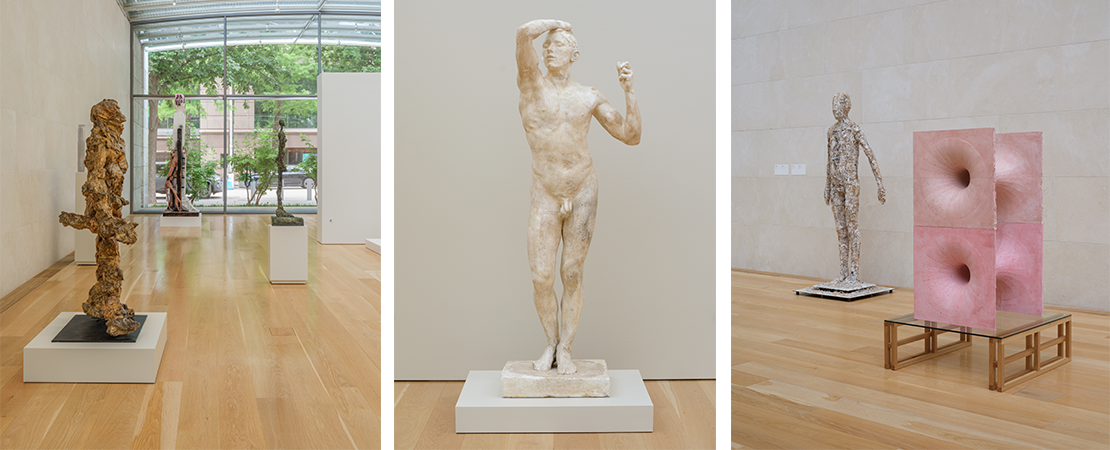
Installation view of Generations: 150 Years of Sculpture, Nasher Sculpture Center, Dallas, Texas, May 17 – August 24, 2025. Photo by Kevin Todora, courtesy of the Nasher Sculpture Center
My attention was then turned towards the lumped and looming Clamdigger (1972) by Willem de Kooning. The Clamdigger is distinctly humanoid, but not quite human. My brain recognizes the misshapen forms protruding from the central mass as limbs and the gouges in the top mound as facial features, and yet a longer look reduces them back to inanimate plaster. The sculpture bounces between these two stages of human and inhuman, the dichotomy of it quite off putting. Approaching the figure evokes a strange feeling, the rhythmic sounds emanating from Jeff Gibbon’s B.O.B.O. (Boat O.A.R. (Oceanic Auto-Reclaimer)) (2020) on the opposing side of the gallery adding a foreboding score to the experience. Its wide stance and bulging shoulders hold the threat of explosive power, as if it might lunge at you if you turned your back to it. Its presence is a stark contrast to the stagnant and straight poses of its surrounding peers, but I can’t help but feel a certain level of understanding for it. There’s a human urge to see ourselves in others– like pointing to a pair of silly looking cats in a medieval painting and saying to your friend “that’s us.” I can look at the haggard Clamdigger and think “yeah… that’s me on a Monday.”
When I first came across Hoeber’s sculpture, I was intrigued by its presence and significance with its neighboring figures. But upon reading the title, an understanding and discomfort settled deep in my gut. While the sculpture doesn’t look like a recognizable human figure, the title and color suddenly renders the cement into flesh. The sculpture pulses with life; its cool, skin colored surface becomes skin stretched and pulled tight. Playing on Hoeber’s interest in oppositional ideas, the chosen medium of manufactured materials (cement) directly contradicts the soft interior of the human body. And yet, this contradiction works. Walking up to the Brutalist Organs creates an uncomfortable feeling of recognition, despite its form being so foreign. The smooth cement makes my stomach twist, as if the sculpture represents my own organs, ripped out, distorted, and put on display. Still, there is an element of vulnerability–the protection of our bones and muscles forcibly stripped away, revealing our intimate inner workings.
My initial impression upon walking into the gallery and seeing the crowd of figures was simply that; they were simply different iterations of how artists have approached depicting the figure through time. However, upon taking the time to stop and sit with each sculpture a little longer, I found it was no longer about the appearance of the figure, but capturing the essence and soul of the human body. The sculptures speak more to humanity than to the human figure.
Georgia Robb is an art history and studio art double major at SMU and a 2025 External Affairs Intern at the Nasher Sculpture Center.