Nestled deep into Fort Worth is Easyside, a space where ideas are born and creativity thrives under the hands of nine artists. One of these artists is Easyside co-founder Corrie Thompson, who was inspired to create the studio because of her experience working for Arts of Life, a Chicago-based studio for artists with disabilities. The experience was particularly formative for Thompson as she began to question who was being given access to art and to articulate thoughts about her shifting relationship with motherhood and mental health. “[Easyside] had also been inspired by the variety of spaces that were always opening and closing in Chicago,” she said. She and her co-founders, Adrianna Touch, Fernando Alvarez, and John Paul Thompson, aspired to create an artist-run space in the Dallas-Fort Worth area, where most places for artists are commercial galleries or museums. “We were thinking about the gaps in the art scene and what artists need in terms of places to experiment, places to make things that aren’t really destined for commercial outcome, and there aren’t a lot of studio spaces in Fort Worth,” Thompson said. A fresh graduate of art school, Thompson looked for ways to emulate the collaboration of tools and studios between artists in that school environment. “Sometimes when you need something, you have to find a way to make it happen with your community,” she said. Now, Easyside hosts a small exhibition program, pop-up exhibitions in other spaces, and a food pantry that serves the local neighborhood—all initiatives reflective of Thompson’s striving to redefine who art is for.
Thompson most often gravitates toward drawing as a medium for her work. Much of her early life was shaped by the dynamism of constantly moving around due to her parents’ work as missionaries. Drawing, Thompson explains, was a means for her to find solace despite the turbulence in her physical place in the world. “I liked drawing, and I liked making things throughout my whole life. I think it was part of my family culture. We moved a lot, so drawing and making stuff was something that was always available, even if we didn’t have friends yet, or all our stuff was in boxes. We could always take out a piece of paper and draw something.”
Her pencil-and-paper drawings, however, have evolved in recent years to involve elements of fabric, textiles, and sewing. “Increasingly, I’ve been drawing on fabric, so my work is sort of jumping off of the flat surface and becoming more of a three-dimensional, soft thing that relates more to the space that the body is in,” Thompson said. This shift from drawing on paper to fabric came organically to Thompson, who learned how to sew from an early age. “My mom taught me how to sew when I was four years old, and it was just part of our toolkit,” Thompson said. “Even before I was working with sewing and textiles in my art, I’ve always used it as a tool in my life. Like when clothes don’t fit, or my buttons fall off, or when I need a new pair of curtains made from sheets.”
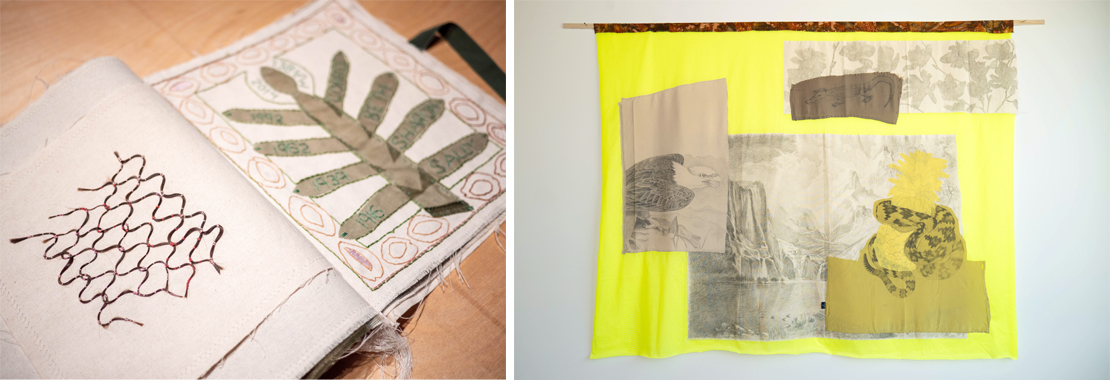
In her pieces, Thompson works with embroidery and quiltmaking traditions, reinventing them with her own imagery. Rather than using traditional quiltmaking or embroidery techniques, she arranges fabrics in a collage style—in her art practice, sewing continues to be a tool for putting things together. This theme of fabric shaping personal history and imagery in Thompson’s works spurred her creation of artist books, which are one-of-a-kind, single-version books. She started making them after completing her undergraduate degree and having a baby: bookmaking presented an adaptable method during a period when time once dedicated to artmaking started to stretch thin. One book Thompson made during graduate school is constructed of muslin and army surplus mosquito netting, so when the pages are flipped, varying levels of opacity reveal a glimpse of the underlying pages.
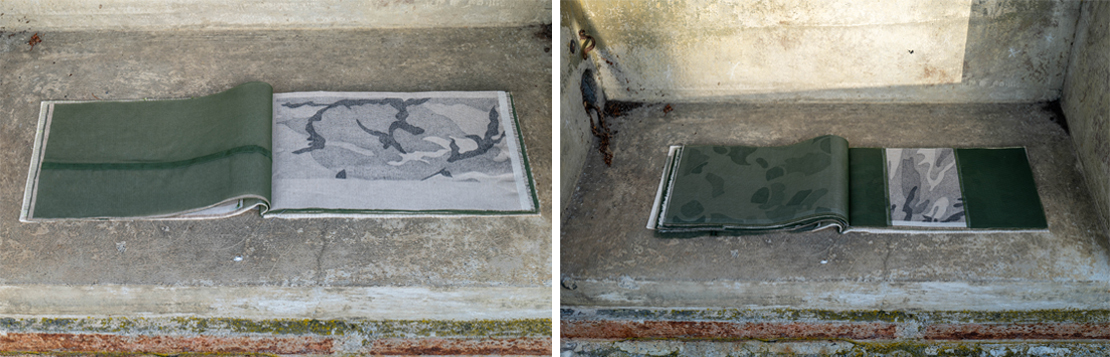
Thompson experimented with visual motifs seen in fabric, such as the embroidery samplers that were once a cornerstone in girls’ education but have since fallen out of fashion. These embroidery samplers forced Thompson to reflect on her place in the family unit, to deal with imagery related to personal history and articulate it through her artistic interpretation. “I was kind of returning to some of the ways those are composed, but using them to revisit my own family’s history. So, to consider what it has meant to be a woman in my family. Particularly because, on my mom’s side of the family, there are three generations of missionaries, and this has led to a lot of generational memory that gets passed down—and baggage that gets passed down.” Thompson said. She grapples with what it has meant in her family to fill the role of a mother, daughter, and sister. “This book was an opportunity for me to sift through all of those layers in different ways and think about what it means for me and what I can pass down to my own kid,” Thompson said. “I would say this is one of my favorite things and definitely one I would never sell; it has been very cathartic for me to make. I don’t think it was particularly innovative in terms of using an art medium, but it kind of felt really good for me to settle into a format that’s been around for a long time and really use it as a way to see my own life.”
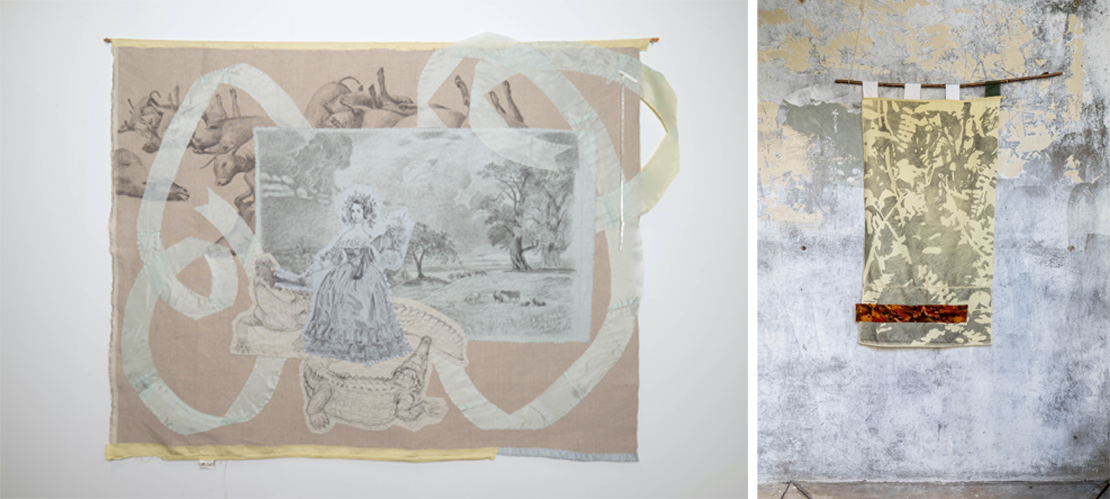
While the book Thompson shared was part of a body of work exploring maternal history, her work also looks beyond personal history, finding patterns in the past that emerge from reflecting on her own lived experience and place in the world. “Increasingly, I’ve been zooming out a little bit more. From that body of work, I was finding all these issues with gender roles, religious and patriarchal systems, and colonization, and looking at how those things have impacted my own story,” Thompson said. “But now, zooming out, I’m looking at ways we’ve used images in American history to create a sense of national identity at the cost of some identities and to empower others.” Thompson sifts through a lot of imagery that is national in scope—from examining paintings of landscapes to looking at when the American eagle started becoming “American” rather than the bald eagle—she extracts images from archival sources and draws them on thrifted fabric. She then cuts out her drawings and sews them together onto a different substrate, leaving her final work hanging on fabric like a curtain or banner.
These aspects of Thompson’s mature practice took time to form. “It wasn’t until college that I decided to pursue art more seriously. And even in college, I wasn’t sure. I don’t think I was thinking very far ahead, to be honest,” Thompson said. Thompson’s family encouraged her to consider double-majoring in education and art, to “study something you can get a job in.” Corrie chose to major solely in art, but even after that, she found herself struggling to proudly introduce herself as an artist. “So it actually probably wasn’t until I was looking at graduate programs and debating between a studio program, art history program, or even social work that I really felt like if I’m going to spend three more years of my life on education, I’m going to do it on something that’s really rewarding,” Thompson said. “At that point, I wanted to be an artist, I knew that much.”
Corrie Thompson's Advice for Artists
“Doing a little bit at a time has been my guiding light. For me, I think, regularity in my practice is the most rewarding rather than big moments of inspiration. Because when I show up more regularly, that’s when I’m able to sustain the thoughts I have in the studio. But if I don’t show up for a month or two and then come back in, I don’t know what to make anymore. And that lack of inspiration can feel really discouraging. But artmaking is like any other habit; it’s not magical, it's like riding a bike, or learning how to bake, or playing soccer. If you don’t practice for a long time, you’re going to miss your goals. So, a little bit at a time will take you a long way.”
Thompson now uses teaching opportunities as a way to give back to other budding artists. Teaching at the Nasher as part of Free First Saturdays is part of a larger relationship with the museum: the Nasher has been part of her life since junior high, when she lived in Arlington.
“I can still remember seeing Jonathan Borofsky’s White Flying Figure with Numbers. It showed me how obsessive and dedicated artists are to their interests and planted a seed for my future creative practice.”
See more of Corrie’s work.
Sophia Lou is a rising senior at the Hockaday School in Dallas, Texas.
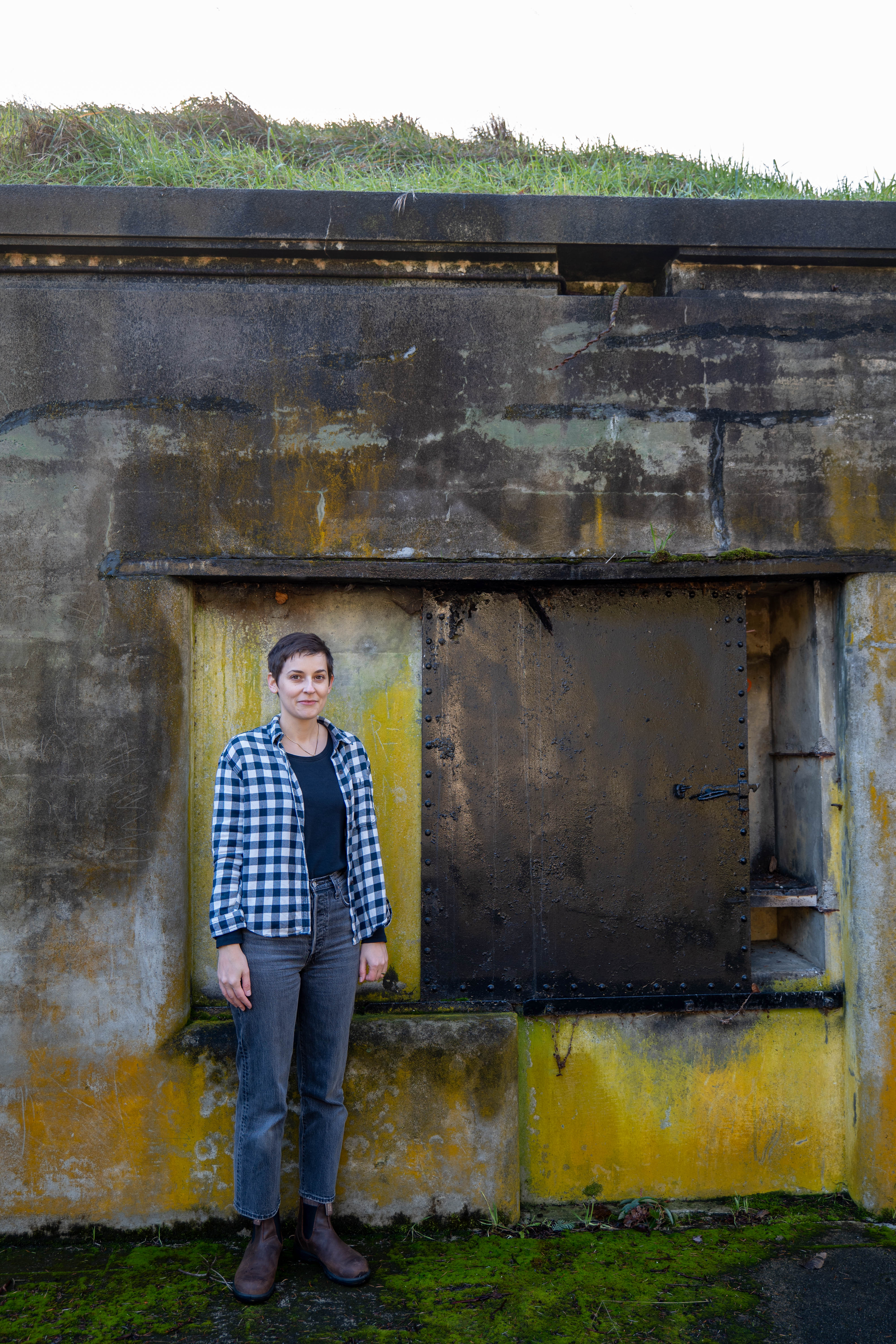
Corrie Thompson is an artist based in Fort Worth, Texas.
Image Credits:
Header: (L): Corrie Thompson a tCentrum Residency, Fort Worden, Washington. (R): Corrie Thompson, The fire becomes the mirror (after Bierstadt), 2024
(L): Corrie Thompson, Source Text, 2022
(R): Corrie Thompson, A certain combination of coast, plain, mountain, valley, forest and stream, 2024
(L) and (R): Corrie Thompson, Undertow (installation view), 2024
(L): Corrie Thompson, We may eat fruit from the trees of the garden, 2024
(R): Corrie Thompson, Untitled (installation view), 2024
All images courtesy of the artist.